
Interview Series: Raquel Sands on Purpose, Presence, Prosperity
About a month ago, I had the chance to meet Raquel Sands. She graciously reached out to me and asked if I’d be open to meeting, I said yes, and we hit it off! She is incredibly thoughtful, kind and gracious.
She and I have talked about careers, transitions and more, and I thought she would be an excellent fit for those of you thinking through your next career steps.
Without further ado, here is my Q&A with Raquel!
Tell me about you!
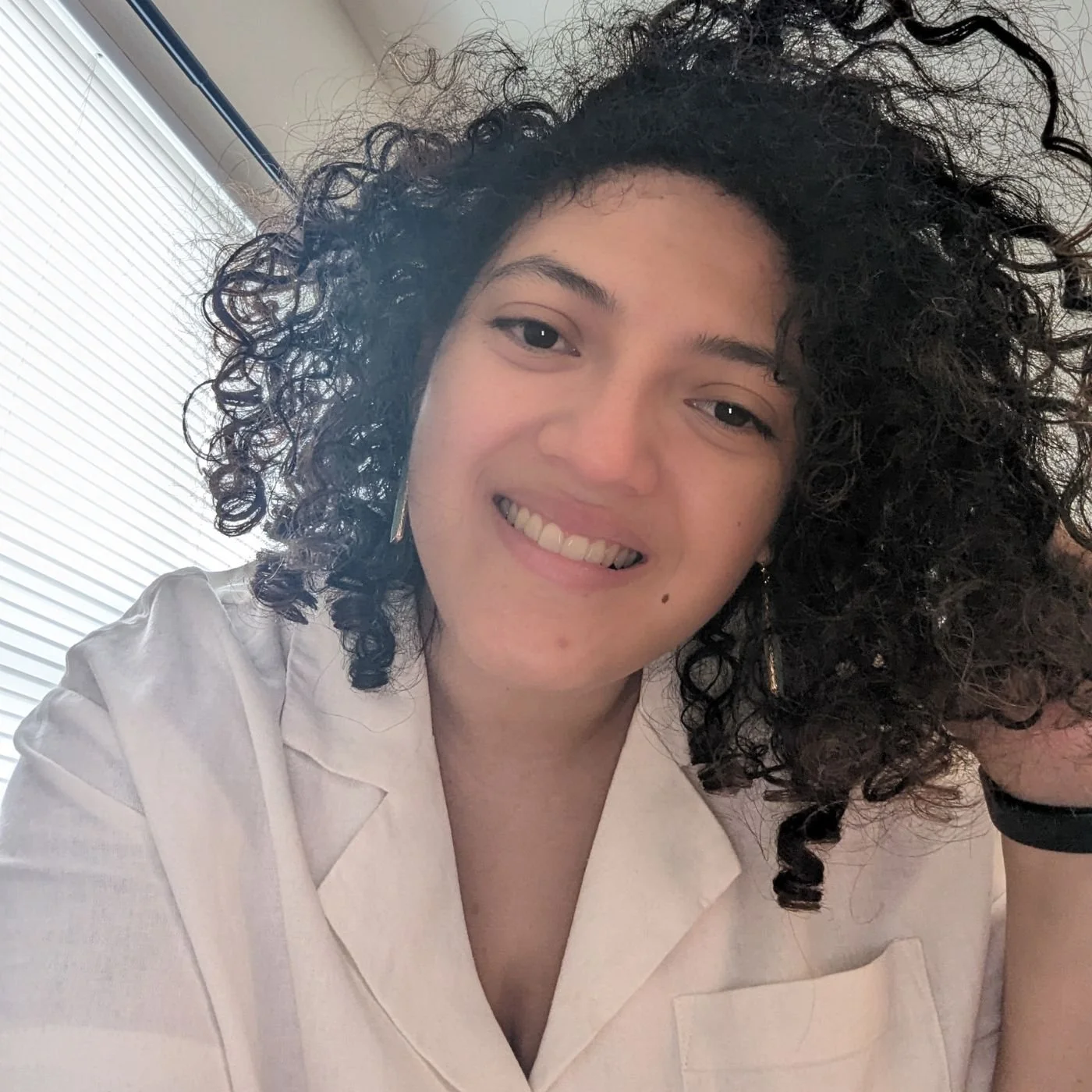
A Portrait of Raquel Sands.
In as few words as possible: I'm a professional communications specialist, graphic and web designer, and first-generation Salvadoran American — deeply motivated by helping people exit extractive corporate systems, or at least repurpose those systems on their own terms.
I graduated with my bachelor's in English in 2014. I chose that degree not because I wanted to make a lot of money, but because I wanted to write, edit, and create for a living — for any organization, regardless of industry, size, or location. That flexibility has never failed me. Over the past decade-plus, I've worked as an employee, a contractor, a consultant, and a freelancer across government, private sector, and nonprofit spaces. Before I turned 30, I paid off $100,000 in student loan and car debt in six years.
I've always been someone who isn't money-motivated. Throwing more money at a situation never made me work harder — it stressed me out more. What has always driven me is meaning. Intentionality. I wanted my life and my work to matter, and I wanted to help others find that same clarity — so that whether they're in a 9-to-5, running a business, or piecing together something entirely their own, they're doing it with full understanding of why.
When I'm not doing that work, I love listening to audiobooks through the Libby app — currently making my way through Marta and I'm a dedicated Agatha Christie fan. I dabble in watercolor painting, walk my French bulldog and corgi as often as I can, and I've recently taken up longboarding. I've never skateboarded in my life, so I'm treating it as an embodiment practice — learning to trust my body, trust the terrain, and figure out how to fall safely or pivot quickly when things feel out of my control.
How did you come to transition & career coaching?
Honestly, I think the work found me — or more accurately, it was always in me, and life just kept removing the excess until it was visible.
I graduated in 2014 with no real concept of what the workforce was going to ask of me. The whole construct of getting a degree to get a job, having that job define your worth through your title or your industry or the size of your company — I was allergic to that from the start. I remember entering my career with a quiet, persistent question: Is there somewhere I can belong while I figure things out?
I started in technical writing and project management. It offered structure when I needed it, but it got too rigid, too devoid of variety and autonomy. So I started job-hopping — not because I had a strategy, but because I was trying to diagnose the problem. Was it the role? The industry? The team? The company culture? I just kept removing what didn't fit.
That organic, sculptural process — I think of Michelangelo's idea that he didn't carve the David so much as remove everything that wasn't the David — that's what my career path was. Slowly uncovering what was already there.
I always had a pull toward working for myself. I was freelancing, taking on consulting and contracting gigs, enjoying the balance of flexibility and structure they offered. But I didn't fully claim the identity of a coach in this space until COVID. That's when I formalized my LLC, started understanding the business world from the inside, and began putting language and framework to what I'd been doing instinctively for years. My podcast gave me a container to really name what I had to say about the workforce — about worth, productivity, value, what it means to show up fully in a capitalist, consumerist, extractive system.
The 3P Method — Purpose, Presence, Prosperity — emerged from that. It wasn't invented; it was excavated.
What questions do you often help guide people through?
The two big ones are: What do I do? And: How do I do it?
I tend to work with two groups of people. The first are in human services, the public sector, nonprofits, or mission-driven environments — places that have historically been underfunded, undervalued, and are now under even more acute pressure. These folks come to me in a kind of survival mode: How do I find a job if the rug gets pulled out? How do I recession-proof my income? How do I future-proof a career built around purpose when the systems that support that work are collapsing?
The second group is straddling — still in a 9-to-5, but moving toward something of their own. A side business, a creative practice, full entrepreneurship. They're asking: How do I make this transition without blowing up my income or my mental health? What's the right trade-off? How do I know what to prioritize?
But underneath both groups, the question I always bring it back to is: Why? Why are we asking the "what"? Why are we asking the "how"? Because those answers tend to unlock everything.
That's the foundation of my 3P Method. Purpose is about getting clear on what you need right now — not just to survive, but to breathe. What's the bare minimum? What are your Plans A through D? Presence is about identifying what actions actually make sense given your purpose — maybe it's your LinkedIn profile, maybe it's your resume, maybe it's building out your business assets. And Prosperity is the outcome — what does success actually look like for you in this season?
The "why" is surprising. Once people take even one or two steps back and witness themselves with a little more objectivity, the what and the how often answer themselves.
What do people struggle with most in transitions?
Trust and patience — and I believe they're two sides of the same coin.
Trust requires that our nervous system, our mind, our spirit be in a state of openness and receptivity. Patience requires trust. Both require a willingness to sit with the unknown. And when we're in survival mode — when everything feels like a threat and we can only see red — it becomes nearly impossible to access either one. We try to solve for solutions using only what we already know, without having done the deeper work to get grounded in ourselves first. That's when people get stuck.
But I'd add a third thing: clarity. Not just trust and patience in the abstract, but clarity about what we're actually transitioning toward or away from — and honesty about what's really driving us.
I had a client who came to me needing job search support. As we worked together, it became clear that what she was actually solving for was her house — maintaining a certain income level to keep it. When I gently pushed back, asking how attached she really was to the house as a lifestyle and not just a symbol, something shifted. It turned out the most viable option was to rent the house to a family member and put it on the market. She didn't resist that practically. What she resisted was the feeling of failure — of having invested so much emotionally and financially and then letting go.
That's the real work. Clarity, honesty, and the willingness to get real about what we want versus what we're afraid to lose. Once that's honest, trust and patience have somewhere to land.
How does your part-time job support your mental and spiritual well-being?
I feel genuinely lucky. My part-time job is 25 hours a week, 30 minutes from home, and it's at a small nonprofit — fewer than 15 people total. I go in twice a week. It started as career counseling, which I still do when the student load calls for it, but it's shifted more toward graphic and web design work — which I actually prefer, because it leaves more emotional and mental bandwidth for my business.
What the part-time job does for me is meet my bills with a little room to spare, which removes an enormous amount of pressure from my business. That pressure, if I let it live inside my business, would warp everything — my decisions, my creativity, my energy with clients. Removing it protects the business and gives it room to be spacious.
I've learned that I need my business to feel spacious. Showing up in this work — meeting people where they are, saying the things I want to say, being fully present — takes real mental, emotional, and spiritual energy. Protecting that is priceless. The part-time job is part of how I do that.
I also found that when I was building the business full-time, there were stretches where I'd run out of things to work on ahead of schedule. Newsletters written, content queued, podcast recorded. I like having structure. I like doing other things. The part-time job scratches that itch without compromising what matters most.
Would a part-time job work for everyone? Not necessarily. The question is always: what are you asking this income stream to do for your life? Is it about income? Benefits? Skill development? Structure? Mental health? Remote flexibility? Knowing what you're solving for changes everything about how you evaluate the options.
Do you have a favorite creative practice?
Lately, longboarding.
I've never skateboarded in my life. I grew up with roller skates — my uncle gave me a pair — so I'm used to trusting my legs to work somewhat independently. Running, yoga, skating: there's always been this bilateral quality to how I move through space. If one leg falters, the other can catch me.
Longboarding removes that entirely. The board is one piece. My body has to be one piece. And those two pieces have to communicate — through my hips, my knees, my legs — in real time, across whatever terrain I'm on. The tennis court in my apartment complex feels completely different from the sidewalk, which feels different from the road. Each surface asks something different of me.
There's something I love about that conversation between body and board in the unknown. The sense of floating, gliding, letting go of control in what I'd call a controlled release. Learning to fall safely. Learning when to jump. It feels like an embodiment practice in the truest sense — trusting my body, trusting the movement, trusting that even when things feel unstable, I can find my balance.
I've also been getting deeply into mind maps lately. A friend reintroduced me to them and I've been using them constantly, especially in my business — to do the root word work, to trace the philosophical threads, to see connections emerge visually in a way that pure writing doesn't always surface. I love words, but there's something particular about seeing them spread out across a page, branching and linking, that opens something up in me.
Do you have a particular intention for 2026?
Getting comfortable being uncomfortable — in my business, in my visibility, in taking up space.
For the past several years, I've been straddling: building a business while holding down a 9-to-5, figuring it out as I go, keeping one foot in each world. 2026 feels like the year I fully step into the business — not by quitting everything else overnight, but by being more purposeful, more consistent, and more present in the work I've built.
I want my business to feel like it has room to breathe and become what it wants to be. And part of that is me showing up for it in ways I haven't always given myself permission to. More space. More consistency. More of me.
What do you most look forward to in your work with clients?
Meeting them.
That first real conversation — getting to know who someone is, what lights them up, what's driven them to this point in their life. I love hearing people's stories. And I especially love the moment when someone starts to see what I can see from the outside: that they have so much more at their fingertips than they realize. More agency. More options. More that's working than not.
There's something genuinely joyful about vibing with people, thinking through things together, and watching them start to trust what's already in them. That's the part I look forward to every single time.
What do you think about the emerging portfolio career trend?
I think it's a bandage, not a cure.
There are genuinely good ideas inside the portfolio career concept — having a side gig, doing contract or consulting work, diversifying your income streams. Those things can absolutely be part of a healthy, sustainable approach to making money. But the way portfolio careers tend to get framed positions them as the solution, and I don't think any single model can claim that title.
The deeper problem — the one portfolio careers don't solve — is that people still don't have real control over the market. You can have five income streams and still be playing defense if the systems those streams depend on are eroding. And right now, they are.
We don't know which jobs AI is going to displace, or how quickly. We don't know what industries will look like in ten years, or even five. When I was job-hopping a decade ago, I was in my own way a portfolio careerist — moving through the system strategically. But there was still a floor. There was still a system sturdy enough to maneuver through. That floor is shakier now.
So what I actually advocate for isn't a specific structure — not a portfolio career, not entrepreneurship, not a 9-to-5. What I advocate for is resiliency. The ability to position your skills, adapt, and build multiple pathways to income in a way that reduces your dependence on any one system — or on money itself, where that's possible.
The real, long-term solution — and I say this knowing it sounds big — is detachment from the system. Not in a way that's irresponsible or impractical, but in the way that if the Titanic goes down, you already know how to swim. You saw it coming. You're not standing on the deck hoping for a lifeboat.
Everyone's path looks different. The right amount of risk, the right mix of income streams, the right timeline — those are specific to each person's skills, circumstances, and intentions. There's no one right answer. But I believe the closest thing to a cure is building enough inner and outer flexibility that the system's instability stops being your emergency.
How can people find you?
The best place to find me is on Substack — my publication is called The Clarity Shift. When you're there, you can grab my free guide, Your Next Step Compass, which walks you through the 3P Method — Purpose, Presence, Prosperity — in a way that maps to your actual life and circumstances right now.
You can also find me on LinkedIn, though I'm more active on Substack. And my website has more about my work and offerings if you want to explore further. You can find my latest podcast episode here.
But if you start anywhere, start with The Clarity Shift on Substack. That's where I live.
Any last words or thoughts?
Give yourself grace.
Before you try to figure anything out — before you strategize or optimize or look for the next step — let yourself decompress. Cry if you need to. Release what you're carrying. Reckon with what you're actually feeling. Because we cannot think our way through a transition we haven't let ourselves feel first. If we don't create space to express, we will eventually implode.
It is already hard to make money in this world. It is already hard to do meaningful work, find meaningful work, and sustain yourself while doing it — in a country defined by complexity, consumerism, and systems built on extraction. That is real. And knowing that, I want to validate something: you are not failing. You are navigating something genuinely difficult.
And here's what I also believe: something is dying. A framework — of work, of worth, of how we're supposed to show up in the world — is ending. And sometimes, without realizing it, we keep applying that old framework to a new situation. We repeat the same stories, the same strategies, the same measures of success, even when they no longer fit.
Now is actually the time. Not to move fast or burn bright or grind harder — but to move as you. As slow or as fast as you need. As juicy or as quiet as you want. The rule book has expired. And what's left, once you let that sink in, is just you — understanding yourself, honoring yourself, and moving from that place.
That's where I'd start. Every time.
Ahhhh! I love this so much. Thank you, Raquel! I will likely make this a series with different creators, coaches and others to get different perspectives, so if you liked this, stay tuned for more!
